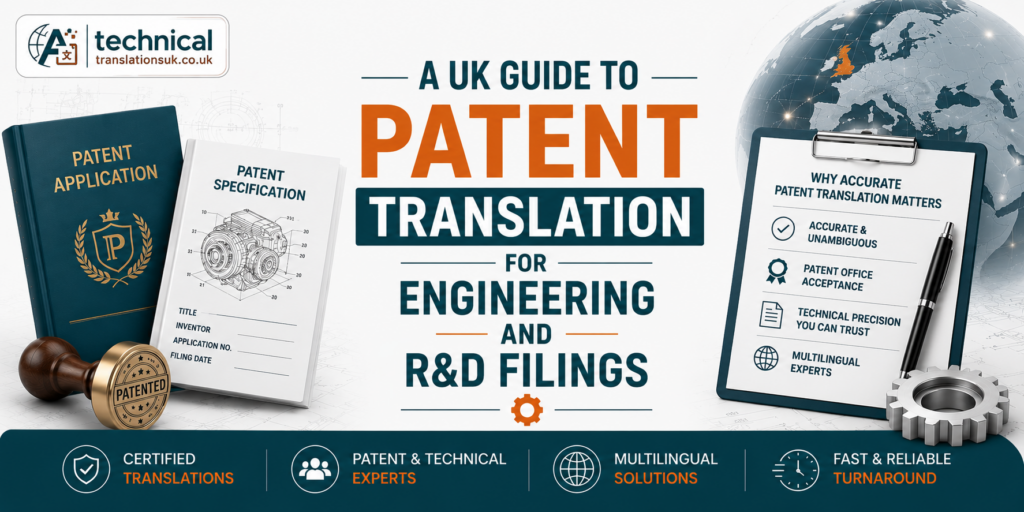
⚡ Quick Answer: Patent translation for engineering and R&D filings is required at several separate stages, not once. Before grant, Rule 71(3) EPC requires the claims to be translated into the other two official EPO languages (English, French and German) within a four-month period that cannot be extended. After grant, Article 65 EPC allows contracting states to require a national translation for validation, generally within three months, though the London Agreement removes or reduces this in many participating countries. Requesting unitary effect adds a further full translation within one month of grant, and PCT national phase entry — 31 months from the priority date at both the UKIPO and EPO — requires translation into each national office’s language. Requirements vary by country, so confirm your position with your patent attorney.
If you’re reading this, there’s a decent chance an attorney’s letter has just landed with a translation deadline nobody in your business knew was coming. A case that’s been quietly progressing for four years suddenly needs claims in French and German, the window is fixed, and your R&D lead is mid-launch on something else.
At Technical Translations UK we handle these enquiries year-round, and the pattern rarely changes. The translation is almost never the hard part. What catches businesses out is not knowing which stages require what, and treating a patent like any other engineering document when it isn’t one.
Why Is A Patent Treated Differently From Every Other Technical Document You Translate?
Because a manual has to be understood, and a patent has to be enforceable. That distinction sounds academic until it costs you something.
We’ve translated a great deal of engineering documentation over the years — maintenance manuals, specifications, test reports. Patents behave unlike all of them. In a manual, a translator who makes a sentence clearer has done good work. In a claim set, clarity that adds specificity is a loss of scope. Write the equivalent of “a bolt” where the original said “a fastening element”, and you’ve limited your protection to bolts in that jurisdiction, permanently.
What attorneys rarely have time to spell out is that the drift runs in one direction. Translators are trained to resolve ambiguity. Patent drafters sometimes create it deliberately. Someone who hasn’t worked with claim language will tidy up exactly the phrases meant to stay broad.
📌 KEY TAKEAWAYS:
✔ Translation is triggered at multiple points in a filing, not one moment
✔ Several of those deadlines cannot be extended under any circumstances
✔ In some countries a narrower translation becomes the text used to judge infringement
✔ Terminology fixed once in the description binds the claims throughout
✔ Filing strategy stays with your patent attorney — providers handle language, not scope decisions
When Does A Uk Filing Actually Require A Translation?
It depends on your route and target markets, and there’s no single moment you can plan around. The matrix below maps the stages that generate translation work for most UK engineering and R&D applicants.
| Stage | What’s generally translated | Typical window | Why it catches people out |
|---|---|---|---|
| Filing in a non-official language | The application, into an official language of the receiving office | Set by the office | Establishes the text everything downstream is examined against |
| Pre-grant at the EPO (Rule 71(3)) | Claims only, into the other two EPO languages | Four months, non-extendable | Lands after years of silence, at a fixed date |
| Requesting unitary effect | Full patent into one further language, transitional arrangement | One month from grant | Window is measured in weeks; the option closes quietly |
| National validation (Article 65 EPC) | Claims or full specification, depending on the country | Generally three months | London Agreement removes it in some states, not all |
| PCT national phase entry | The application, into each national office’s language | 31 months at UKIPO and EPO; 30 in many others | Several jurisdictions hitting at once |
Two of those cause more trouble than the rest combined.
The pre-grant claims translation is the first. When the examining division signals it intends to grant, you’re invited to approve the text, settle the fees and file claim translations into the other two official languages within a period that genuinely cannot be extended. The volume of work is small. The timing is what hurts.
Unitary effect is the second. The request must be accompanied by a further full translation, and the window after grant is short enough that if nobody has commissioned it in advance, the option can lapse before anyone notices it was available.
The fix for both is the same: commission the translation when allowance starts looking likely, not when the communication arrives.
What Happens If The Translation Is Narrower Than The Original Patent?
This is the part almost nobody mentions, and it’s why we treat patent work differently from the rest of our engineering translation.
In several countries, where the filed translation turns out to be narrower in scope than the text as granted, it’s the translation that’s treated as authentic for determining infringement. The original doesn’t automatically rescue you. A cautious, over-specified translation can hand a competitor room your patent was drafted to close off — and you typically discover this years later, during a dispute.
The reverse error is no safer. A translation that broadens a claim, or introduces a feature that wasn’t in the original, invites an added-matter objection. There’s no safe direction to drift in. The only workable target is faithful mapping of scope, which needs someone who has read claim sets before, not just someone who knows the engineering.
What Makes Engineering And R&D Patents Harder To Translate Than Most?
Engineering patents stack legal drafting on top of dense domain content, and both have to survive at once. These are the pressure points our specialists watch most closely:
✔ Claim terms must stay locked to one referent.
If the description calls something a “housing” in paragraph 12, it can’t become “casing” in paragraph 40 and “enclosure” in the claims. English drafting usually holds this line. Translation collapses it easily, particularly into compound-forming languages like German.
✔ Reference numerals tie the text to the drawings.
Every numeral must still point at the same feature in the same figure, and text inside the drawings needs handling too. This is where flattened PDFs cause the most damage.
✔ Ranges and tolerances are claim-critical.
A tolerance with a converted unit, a shifted decimal separator or a rounded boundary is a changed claim. We run numerical content as a separate verification pass.
✔ Established terms may already exist in the target language.
Most engineering fields have settled equivalents in German, Japanese, Chinese and Korean prior art. Coining something fresh where a conventional term exists makes your patent read as an outsider document to an examiner.
📌 The subtlety most generalists miss: consistency across a patent family matters as much as consistency within one document. Diverging from earlier translations without reason creates inconsistency that opposition counsel can point at later.
Where Do Engineering Patent Translations Most Often Go Wrong?
We frequently see R&D teams get caught out by problems that have nothing to do with linguistic ability, and everything to do with what was sent and when.
The wrong version goes out.
Prosecution amends claims, sometimes repeatedly. Sending the as-filed text when the allowed text is what matters produces a translation of a document that no longer exists. Confirm the authoritative version with your attorney in writing.
The file arrives as a flat PDF.
Text becomes uneditable, drawing labels become images, and reference numerals get rekeyed by hand — introducing errors into precisely the content where errors are least survivable. Editable source files aren’t a preference here, they’re a risk control.
Internal terminology never gets shared.
Your R&D group has its own names for subsystems and components. Without that list, reasonable guesses get made, and the same part ends up described three ways across three jurisdictions.
Machine output gets a light edit and goes out.
It reads fluently and drifts quietly. Fluency is not the quality signal in patent text — scope fidelity is. Machine translation earns its place elsewhere, skim-reading foreign-language prior art to decide whether a document matters at all.
The unpublished specification gets pasted into a public tool.
Worth stating plainly: that’s a disclosure risk in itself, whatever the translation quality.
Frequently Asked Questions
Do Patent Translations Need To Be Certified?
Usually not in the sense civil or immigration documents do. Some offices ask instead for a verification or declaration of accuracy. Requirements differ by jurisdiction, so check the specific office’s position with your patent attorney.
Does The Entire Specification Need Translating, Or Just The Claims?
It depends on the stage and country. The EPO’s pre-grant requirement concerns claims only. Some national validations require the full specification; others require nothing at all under the London Agreement.
Can A Translation Error Be Fixed After Filing?
Sometimes, but the routes are limited, vary by jurisdiction, and may not restore scope lost in the filed text. Raise it with your attorney immediately — timing usually determines what remains available.
Is A Technical Translator The Same As A Patent Translator?
No, though they overlap. A technical translator optimises for the reader’s comprehension. A patent translator preserves the structure and deliberate breadth of legal drafting alongside the technical content. Engineering patents need both skills in one person.
How Is Our Unpublished Invention Protected During The Work?
Ask any provider directly. Look for restricted-access workflows, named specialists under confidentiality terms, secure file transfer, and a written position on whether public machine translation tools touch your files at any stage.
📌 Protect Your Invention In Every Market You File In
Patent work isn’t handed to whoever is available. Our specialists combine genuine subject-matter grounding — mechanical, electronics, materials, chemistry, software — with real experience of claim language, so scope is preserved rather than quietly tidied away. Terminology is fixed before translation begins and locked across your whole patent family. A second specialist then reviews the finished text for scope fidelity, checking whether anything has been narrowed, broadened or added. Unpublished specifications stay inside restricted workflows under confidentiality terms, and never go near public tools.
Send us the specification before you commit to anything. Our in-house specialists will tell you honestly what needs translating, what your source files allow, and what timeline is realistic against your deadline. If a communication has already landed, say so and we’ll work backwards from the date.
Request your free patent translation review and get a clear quote before the window narrows.