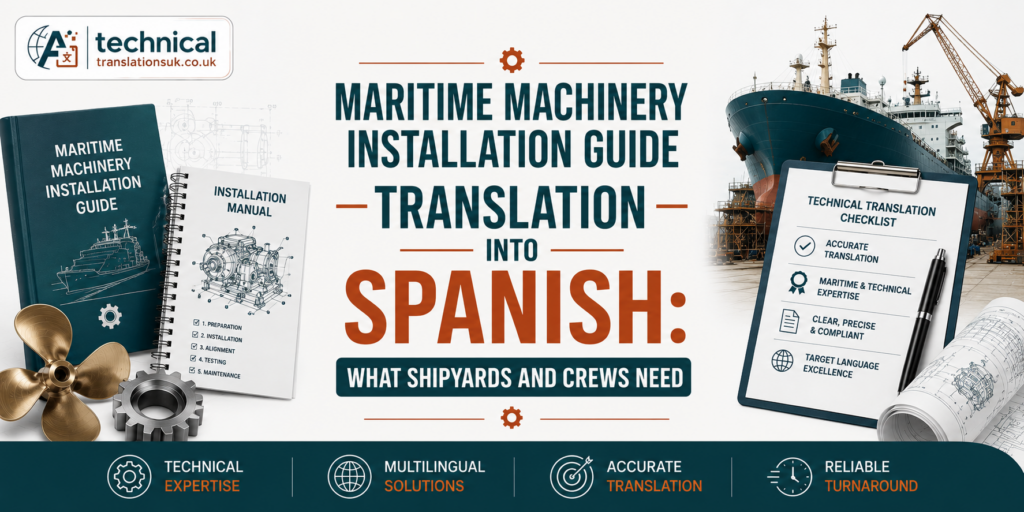
⚡ Quick Answer: Maritime machinery installation guide translation into Spanish is driven by the vessel’s working language rather than a single blanket rule. SOLAS Chapter V Regulation 14 requires every ship to establish a working language and record it in the log-book, and Port State Control inspectors routinely raise deficiencies where training manuals and booklets are not written in that working language. Under SOLAS Chapter III Regulation 8, emergency instructions must be provided in the language or languages required by the flag State and in English. For equipment sold into Spanish-speaking yards and fleets, the practical requirement is documentation commissioning engineers and crew can actually work from — and the correct regional variant of Spanish matters. Confirm specific obligations with the flag State, class society and yard contract.
Most marine enquiries reach us the same way. A UK manufacturer has won an order — a separator, a winch package, a ballast water system — and somewhere in the yard’s document schedule sits a line asking for the installation and commissioning documentation in Spanish. Nobody costed it. The shipment date hasn’t moved.
At Technical Translations UK we see this across Spain, Panama, Chile, Peru and Mexico. The manual gets treated as paperwork, when it’s the thing standing between your equipment and a smooth commissioning. Get it wrong and the fitter on the deck plates improvises.
Why Does The Language Of An Installation Guide Matter More At Sea Than Onshore?
Because the people using it are often not the people who bought it, and they can’t ring you mid-job. A factory technician onshore can walk to an office and ask. A fitter installing your unit in an engine room in Callao at two in the morning cannot.
We frequently see manufacturers get caught out by assuming the yard’s engineering office speaks English, so the documentation can too. The engineering office usually does. The subcontracted installation crew, the electrical fitters and the vessel’s own engineers frequently don’t — and they’re the ones holding the guide.
There’s a second layer that bites later. Once your equipment is installed and the vessel is trading, your operating and maintenance documentation becomes part of the ship’s onboard documentation set — and stops being your commercial concern and becomes the operator’s compliance concern.
⚠️ CRITICAL COMPLIANCE WARNING: SOLAS Chapter V Regulation 14 requires every ship to establish a working language and record it in the log-book. Port State Control inspectors regularly record deficiencies where training manuals and booklets are not in the ship’s working language, and crew unfamiliarity with onboard manuals is a recognised ground for a negative inspection finding. If the vessel’s working language is Spanish and your equipment documentation is English-only, that gap sits on the operator’s inspection record — and it comes back to the supplier. Confirm the position with the flag State and the vessel’s operator.
What Does The Working Language Rule Actually Mean For Your Documentation?
It means there’s no universal answer, and anyone telling you “SOLAS requires Spanish manuals” is oversimplifying. What the framework establishes is a chain: the ship declares a working language, safety-critical documentation must be usable in it, and inspectors test whether crew can demonstrate familiarity.
Commercially that’s straightforward. If your equipment ends up on a vessel running Spanish as its working language, or in a yard where the installation trades work in Spanish, the documentation needs to function in Spanish — regardless of what the purchase order technically obliged you to supply.
Alongside that sit contractual requirements, often stricter than the regulatory ones. Classification societies including Lloyd’s Register, DNV and Bureau Veritas have their own documentation expectations for survey and approval, and Spanish and Latin American yards frequently write language requirements into the supply contract. Those are the ones that hold up your payment milestone.
European Spanish Or Latin American Spanish — Which One Does Your Yard Need?
This is the question almost nobody asks, and it separates documentation that works from documentation that reads as foreign. Spanish is not one target. A manual for a shipyard in Cádiz and a manual for a fleet operator in Panama should not be identical files.
| Consideration | Spain (European Spanish) | Latin America |
|---|---|---|
| Plural address in instructions | vosotros forms appear in some instructional registers | ustedes is standard throughout |
| English technical loanwords | Lower tolerance; Spanish equivalents preferred | Higher tolerance, especially in engineering and IT terms |
| Number formatting | Comma decimal separator is standard | Varies by country — Mexico and Peru commonly use the point; Argentina and Chile the comma |
| Regulatory reference points | EU and UK-aligned marine equipment frameworks | National maritime authorities vary by country |
| Terminology sourcing | Established Spanish marine engineering vocabulary | Often shaped by US-sourced equipment documentation |
What yards rarely tell you upfront is that the wrong variant doesn’t get rejected — it quietly reduces confidence in your documentation and generates avoidable questions during commissioning. If you supply several Spanish-speaking markets, decide early whether you want one neutral version or market-specific ones. Both are legitimate. Choosing by accident is not.
How Should A Maritime Installation Guide Be Prepared For Spanish Translation?
This is a sequence, not a single task. It’s the workflow our specialists run on marine equipment documentation.
Step 1 ➔ Confirm the destination and the audience. Establish the yard, the country, the vessel’s flag and its working language before anything is quoted. These four facts determine the Spanish variant, the terminology set and whether safety-critical sections need separate handling. Skipping this is the commonest reason a manual gets reworked afterwards.
Step 2 ➔ Separate the document into functional layers. Installation and commissioning content, operating instructions, maintenance schedules and safety warnings each carry different risk. Warnings and lock-out procedures get the highest scrutiny; a parts list doesn’t need the same treatment. Splitting them puts budget where consequence lives.
Step 3 ➔ Supply editable source files, including drawings. Marine guides lean on exploded views, torque tables, schematics and callouts. Send native files rather than flattened PDFs so labels stay extractable, and flag any text sitting inside images early.
Step 4 ➔ Lock terminology before translation starts. Your part names, system designations and any yard-specified vocabulary go into a glossary governing the whole document. This matters more here than most sectors, because the same component may be named differently by the OEM, the yard and the class society.
Step 5 ➔ Verify warnings, units and torque values as a separate pass. Every figure, tolerance, pressure rating and torque value is checked against the source independently of the prose. A misplaced decimal in a torque specification isn’t a language error — it’s a mechanical failure waiting for its moment.
Step 6 ➔ Run a second review focused on usability. Could a fitter with the document in one hand and a spanner in the other follow it? That’s a different test from linguistic accuracy, and it catches what accuracy checks miss.
Step 7 ➔ Preserve the layout. Section numbering, figure references and page structure should mirror the original, so your service engineers and the yard can work from both versions side by side during commissioning.
Where Do Marine Installation Translations Most Often Fail?
In our years of translating equipment documentation for marine exporters, the failures rarely come down to vocabulary.
✔ Text expansion breaks the layout.
Spanish typically runs longer than English. Callouts overflow, tables break across pages, warning panels stop fitting the space designed for them. Plan for it before translation, not as a repair afterwards.
✔ Safety warnings get softened.
Direct English imperatives drift into polite constructions that read as advisory rather than mandatory. On a lock-out or confined-space instruction, that shift is dangerous.
✔ Drawing callouts get left in English.
The prose is translated, the figures are not, and the guide becomes half-usable exactly where the fitter needs it most.
✔ Every revision restarts from scratch.
Without translation memory, each equipment update is re-translated in full — paying repeatedly for unchanged content and drifting terminologically with every pass.
✔ The variant is chosen by whoever was available.
Work gets shaped by one country’s conventions without anyone deciding that was right for the destination.
Frequently Asked Questions
Does Solas Require Equipment Manuals To Be Translated Into Spanish?
Not directly. SOLAS establishes that a ship must declare a working language and that safety-critical documentation must function in it, so the obligation follows the vessel rather than the equipment. Confirm the position with the flag State and operator.
Do The Drawings And Diagrams Need Translating Too?
Yes, wherever they carry text. Callouts, labels, warning panels and legends should be translated while part numbers and reference numerals stay unchanged. Supplying native drawing files rather than exported images makes this far cheaper.
Should We Produce One Neutral Spanish Version Or Separate Regional Ones?
One neutral version works when you supply several Spanish-speaking markets and want a single controlled document. Separate versions are worth it when a specific yard or fleet is a major account. Decide deliberately rather than defaulting.
How Do Repeat Manuals And Equipment Updates Get Handled?
Through translation memory and a locked glossary, so unchanged sections carry across and only new or amended content is translated fresh. This keeps terminology stable across a product range and cuts cost on every revision.
Can Machine Translation Handle Marine Technical Documentation?
Not for installation, commissioning or safety content. Machine output reads fluently while softening imperatives and misreading domain-specific terms, and neither failure is visible to a reviewer who doesn’t know the equipment.
📌 Ship Your Equipment With Documentation The Yard Can Actually Use
Marine documentation isn’t handed to a general translator. Our specialists work with engineering and industrial content daily and understand how installation guides get used — under time pressure, in an engine room, by someone who won’t be phoning your technical desk. Terminology is locked before translation begins and carried across every revision. Warnings, torque values and tolerances are verified as a separate pass. Layout is preserved so your service engineers and the yard can work from both versions side by side. Your drawings and commercial data stay inside restricted, confidential workflows throughout.
Send us the manual, the drawings and the destination yard before you commit to anything. Our in-house specialists will confirm which Spanish variant fits, what your source files allow, and what timeline is realistic against your shipment date. Request your free marine documentation review and get a clear quote while there’s still room in the schedule.