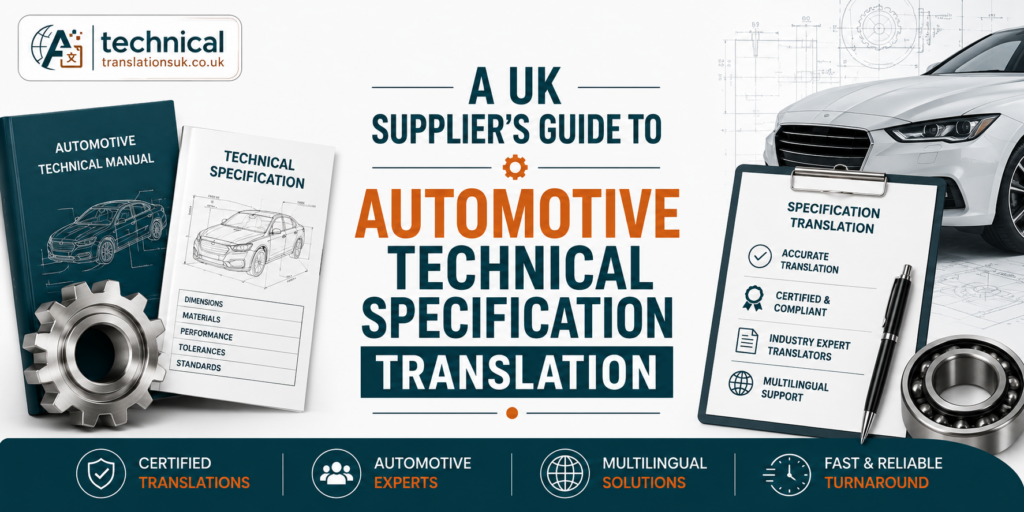
Quick answer: ➔ Automotive technical specification translation must preserve four things exactly: numerical notation and units, material and standards designations, drawing callouts and symbols, and the customer’s own approved terminology. Everything else can be rendered naturally. Agree those four with your OEM contact before translation starts, capture the decisions in a glossary, and keep a version record — that combination is what makes a submission survive review and an audit.
A West Midlands supplier once called us about a supplier quality notification from a German OEM. A machined component was being rejected against a dimension their own inspection data said was correct. Three days of engineering time went into re-measuring parts that were never out of tolerance. The actual cause sat in the translated drawing note: a tolerance written as 0.05 had been rendered with a decimal comma in a document where the surrounding text used decimal points. Nobody had mistranslated a word. Somebody had allowed two numerical conventions to exist in one controlled record — and in automotive documentation, that is enough.
Over the years at Technical Translations UK, we have found that specification work almost never fails for linguistic reasons. It fails because a specification is a controlled record, and controlled records answer to rules that ordinary documents do not. This guide sets out those rules from the perspective of the people who will actually judge your paperwork.
How Oem Reviewers Read A Translated Specification
They do not read it. They spot-check it — and knowing what they check changes what you protect.
They compare it against what you sent before. If a component appears under one name in last year’s control plan and another in this drawing pack, the reviewer does not see improved wording. They see a possible change to the part, and they stop. Consistency across years outweighs quality within any single document.
They verify numbers against the source drawing. Values, units, tolerances and notation are checked directly. This is the fastest failure route in the process, and the one with no benefit of the doubt.
They ask who stands behind it. Quality functions increasingly want to know who produced a translated controlled document, whether it was independently checked, and which revision it corresponds to. Perfect content with no record behind it is still difficult to defend in an audit.
💡 The suppliers we see who are never questioned are rarely the ones with the most polished documents. They are the ones whose terminology has not moved in four years.
The Four Risk Zones In Automotive Technical Documentation Translation
Nearly all the corrective action we are asked to help with traces back to these four places. Our Midlands supplier lost three days to the first row of this table.
| Risk zone | Where it appears | Why review fails | How it is prevented |
|---|---|---|---|
| Numerical notation | Tolerances, torque values, dimensions | European locales use a decimal comma — a misread separator changes a value by orders of magnitude | Locale rules fixed and locked before work starts; values verified in a pass separate from the prose |
| Standards and materials | Material grades, surface treatments, test standards | Designations are identifiers, not descriptions; translating one severs traceability to the standard | Locked as do-not-translate entries in the term base |
| Drawing text | Callouts, section labels, GD&T notes | Text is extracted from CAD or DXF, translated away from its context, then dropped back into fixed space | Translated with the drawing visible, then re-checked in position after reinsertion |
| Customer terminology | Part, system and process names | The OEM has approved vocabulary and expects to see it — a correct synonym is still wrong | Term base harvested from the customer’s own returned documents |
✔ The most useful thing you can do costs nothing: decide what must not be translated before anyone opens a file. Designations, codes, part numbers, standards references, any term the customer has fixed. That short list removes most corrections before they can occur.
Building An Approved Glossary For Oem Specification Translation
In automotive work the glossary is not administration. It is the mechanism that keeps every future submission consistent with every past one — and it is what our West Midlands supplier did not have.
➔ Harvest it from the customer, not a dictionary. Their returned drawings, purchase specifications, supplier quality manual and audit correspondence already contain the vocabulary they expect. Building from those sources means matching their language rather than proposing your own.
➔ Have a named person approve it once. Your OEM engineering contact or in-market quality representative signs off a defined term list. It is a short review, and it turns every future disagreement into a question that has already been answered.
➔ Version it alongside the documents. When a term changes, date and record the change. Auditors ask why wording differs between two revisions far more often than suppliers anticipate.
➔ Extend it — never restart it. Each new programme adds terms to the existing base. Suppliers who start fresh per customer end up with one component named three ways across three OEMs, which is exactly the inconsistency reviewers are trained to catch.
If your documentation is being scored competitively rather than simply accepted, our guide on choosing a translation partner for competitive bid documentation covers what changes when the paperwork is being marked.
Assembling A Ppap And Quality Document Pack That Survives Review
Submission packs fail as packs, not as individual files. Build them in this sequence.
1. Confirm scope against the customer requirement, not your folder structure.
Some OEMs require the control plan and work instructions translated while accepting drawings and test reports in English. Ask before you price anything — it is the only way to reduce cost and risk in the same decision.
2. Set the language variant by receiving plant, not by country.
A Spanish OEM with Mexican operations is two markets. A pack going to a plant in Slovakia is decided by that plant, not the head office address on the purchase order.
3. Translate interlinked documents together.
FMEA, control plan and work instructions cross-reference one another. Handled separately, at different times, by different people, they drift — and reviewers cross-check them precisely because they should align.
4. Verify numbers as a separate pass.
Every value, unit, tolerance and revision number is checked against the source by someone reading it as data, not as language. Errors hide inside fluent sentences, never inside obviously broken ones.
5. Check drawing text after reinsertion, not before.
Longer German or Czech text in a fixed annotation box is a failure that only becomes visible once the callout sits back in the drawing.
6. Log the revision and keep the memory.
Record which document revision the translation matches and who verified it. That record answers an audit question in thirty seconds rather than thirty emails — and the stored memory means the next revision is translated and priced against changed content alone.
📌 What we ultimately implemented for the Midlands supplier was unremarkable: a locked numerical convention, an approved term list signed off by their customer’s engineering contact, and a verification pass on values. There has been no repeat notification since, and their last three PPAP packs went through without a query.
Frequently Asked Questions About Automotive Specification Translation
Does Translated Documentation Need To Be Certified For An Oem Or Iatf Audit?
Certification in the legal sense is rarely what is being asked for. What quality functions want is traceability — evidence of who produced the translation, that it was independently checked, and which revision it belongs to. Ask your customer precisely what record they expect, then confirm your supplier provides it as standard rather than only on request.
Who Is Liable If A Translated Specification Error Reaches Production?
Liability normally follows your supply contract with the OEM rather than your translation arrangement, which makes internal verification a commercial safeguard and not just a technical one. Make sure your supplier agreement covers correction obligations, and keep your own engineering sign-off in the chain so an error is caught before it becomes a production event.
Can Our Bilingual Engineers Translate Specifications In-House Instead?
Native fluency and specification discipline are different capabilities. Bilingual engineers are extremely valuable as reviewers because they know the product and the customer — but producing controlled documents in-house usually means terminology drifting between submissions, no verification record, and a real cost in engineering hours you had budgeted for engineering.
How Do We Handle Documentation For A Programme That Is Still Confidential?
Say so at first contact. Unreleased programmes, prototype specifications and customer-confidential data are handled under confidentiality agreements through access-restricted workflows, with access limited to the specialists assigned to your account, so pre-launch documentation can be prepared without exposure.
What Should We Do With Specifications Translated Years Ago By A Previous Supplier?
Keep them. Existing translations can be aligned into a translation memory and term base, which recovers your historic terminology, keeps new documents consistent with what your customer already holds on file, and reduces the chargeable volume on future work instead of paying twice for the same content.
Talk To Us Before Your Next Submission, Not After The Notification
Automotive documentation is unforgiving in one very specific way: the cost of an error is never the cost of the words. It is the corrective action, the resubmission, and the credibility you spend explaining it to a customer who audits you every year.
Send us a representative specification with its drawings — ideally the awkward one, with dense callouts and a full tolerance stack. Our specialists will show you exactly what stays locked, how the values are verified independently, how your terminology would be captured for every programme that follows, and what record you would be holding at your next audit.
➔ Send us a specification and drawing set for a technical assessment, and you will receive a clear scope, a fixed quotation and a submission process you can put in front of your OEM contact with confidence.